


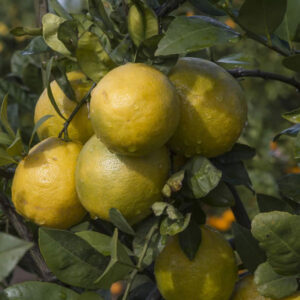
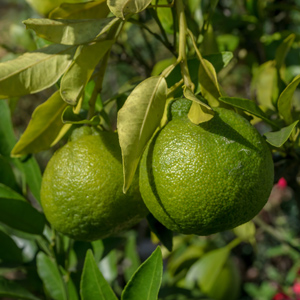
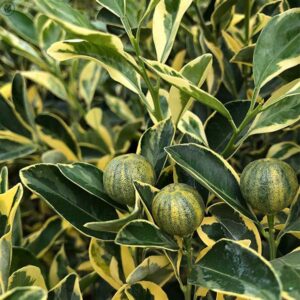
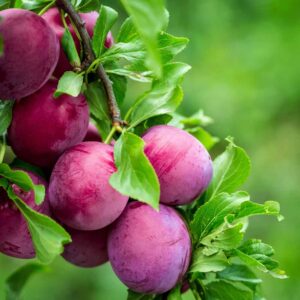




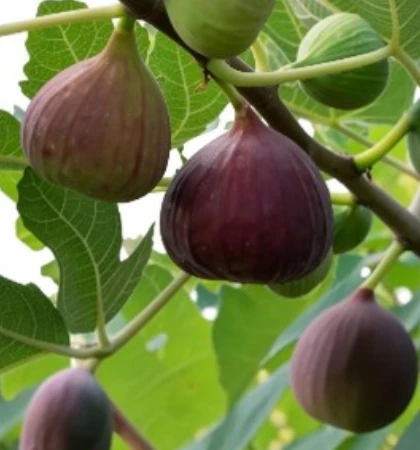

Pineapple Guava (Acca sellowiana), also commonly called Feijoa, are delicious and unique fruit popular in New Zealand, but not widely known in the United States. We are on a mission to bring these incredible fruits to your backyard so you can enjoy the sweet, tangy, mint, flavor they have to offer.
Jump to: About Pineapple Guavas, Site Selection,
ABOUT PINEAPPLE GUAVAS
Origins: The Feijoa shrub is native to southern Brazil, northern Argentina, western Paraguay and Uruguay where it is common in the cool subtropical mountains below 3000’. The plant was introduced to Europe, New Zealand and the US around the early 1900s.
This evergreen shrub can easily reach heights of 12-15 ft. The top of the leaves is dark green and glossy. The underside of the leaf is fuzzy with a bright silver color. This tree is sometimes planted just for its attractiveness in the landscape. When planted close together they make a perfect edible privacy hedgerow and function as a dense windbreak. Birds love to nest in the branches too! The wood is very dense but small branches easily snap because of its brittle nature. Untouched the natural form of Feijoa is multibranched, however, it is possible to shape it as a single trunk. It is even possible to form an espaliered tree or make it reach 20+ feet tall.
Pineapple Guava flowers are stunning explosions of red with delicious edible pink to white sepals around the outside. It’s hard to describe the joy that a plant can provide not only for its fruit but also its flowers. This plant is incredible for just that reason. When the flowers come on in the spring the bush becomes a show of fireworks. The bush is literally covered in red, white on the backdrop of green leaves. The white edible sepals are thick marshmallow-like pillows of sweet melt in your mouth cotton candy. The smell and fragrance are beyond comparison but it is very much a preview of the smell of the fruit. It is best to hand pollinate the flowers while snacking on the sepals.
SITE SELECTION
Feijoa can grow anywhere the temperatures do not fall below 15 degrees Fahrenheit. Growing best in temperate to sub-tropical regions with cool mild winters and moderate summers in the 80-90s. The minimum chill requirement is 50 days in order to get flowering. In California coastal areas especially around San Francisco, there is some commercial planting as well as it being commonly found in landscaping. Here in Portland, OR the climate is also perfect for these plants. We see the best fruit production in the south-facing position up against a hardscape or building here in the Pacific Northwest.
Soil and Sunlight
Choose a site that is protected from wind and temperatures over 100 degrees. Make sure the site is well-drained with ½ day to full-day sunlight.
Feijoas prefer sandy loam, well-draining soil with lots of organic matter. You can grow them in clay soils too so long as they are not saturated in the winter. Again adding compost to the soil is definitely recommended. pH should be around 6 – 6.5 on the scale.
Spacing
This depends on your situation but if you are planning an orchard the spacing should be about 8-10 feet apart with at least 15 feet between the rows. At home or in the landscape you can plant them closer and in hedgerows, we have seen them as close as 5 feet apart.
WATERING & FERTILIZING
Watering
While Feijoa is drought tolerant it must be watered in to get established. After about 3 years it can survive the dry summers of Oregon without irrigation. However, if you want to eat delicious fruit- which we know you do, then deep weekly watering during flowering through fruit formation is critical. If the plant perceives stress it will abort the fruit and diminish the yield.
Fertilizing
Pineapple Guavas are heavy feeders and require good compost mulch and regular addition of a balanced fertilizer in order to maintain production and replenish nutrients. Mulching ensures that the shallow roots are protected as well.
POLLINATION
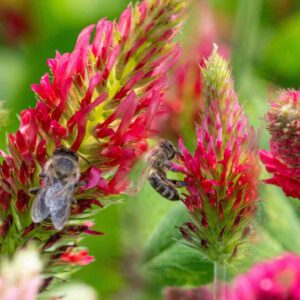
The bi-sexual flowers are often self-incompatible so you must plant two or more named types together in order to get cross-pollination. Seedlings are also good as pollinators. It is thought that birds are the native pollinators, coming in to eat the sweet sepals we described above, but bees also do a good job too. The absolute best way though is to hand pollinate some of the flowers and ensure you get fruit. There are also self-fertile cultivars like Coolidge and Apollo.
CULTIVAR SELECTION
Cooler and more temperate climates like ours in the Pacific Northwest, will want to select for earlier blooming varieties. Since we don’t experience consistently hot fall temperatures while the pineapple guavas are ripening, we want them to begin developing fruit as early as possilbe, therefore exposing them to as much heat units as possible. Our top recommendations for climates like this are Unique, Ramsey, Anatoki, Kakariki, and EarliHart. Warmer southern climates can have their pick of varieties!
PRUNING
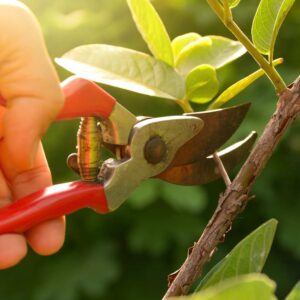
In commercial production, the plant is pruned into a single leader with the inverted umbrella shape and an open center. Although it is not necessary to prune in this fashion or even at all the idea is to get light and air penetrating into the canopy in order to ripen fruit. Be careful not to prune too much in the summer and avoid sunburned fruit. Some people prefer to hedge their plants which seems to work just fine and they still get a moderate amount of fruit. Some people find that they get too many fruits and can’t eat them all!! Yeah those people- you know who you are, just don’t forget to call us over so we can help you with that problem, okay?
HARVESTING
This is the best part! All that work you did hand-pollinating is going to pay off now. So, depending on where you live and the season, the fruit ripens at different times and in stages over a few weeks to a month. The best way to pick them is by not picking them at all actually. If you have some way to put a net, tarp or cloth down and shake the tree you get the sweetest fruit to fall. If you decide you can’t wait to let them fall then pick them by touch. The mature fruit should be soft to the touch. You can let the mature fruit ripen fully on the counter. They can be stored in the fridge but the quality declines quickly within a couple of weeks.
Bruising is the main issue for fruit quality and probably the reason why you don’t see this fruit offered much in the US. However, in New Zealand, the fruit has reached super-fruit status and is found in every supermarket and farmers market in the country during the fall season. During the rest of the year, the Kiwis enjoy a whole range of products made with Feijoa. The favorites being freeze-dried, juice, smoothies, and a unique and fragrant sparkling wine. But they even have breakfast cereals made with Feijoa fruits!
ENJOYMENT
Our favorite way to eat them is fresh right after they have fallen. A fallen Pineapple Guava has a very limited shelf life- maybe only a few days, which means you must eat them right away, share them or process them. Cut an end off just deep enough to reveal the jelly-like center, and use a spoon to scoop out the pulp. Be sure to run the spoon as close as you can to the skin. Some thin-skinned cultivars like Apollo and Nikita can be enjoyed when eaten whole. However, most of the varieties have a tannic and tart skin which is best removed when fresh-eating, but can absolutely be boiled down for its pectin!
PROPEGATION
Pineapple Guava can be grown from seeds, cuttings, layering, and grafting. We use seeds, cuttings, and grafting in our production. Recently, we found grafting to be most successful achieving fruiting much sooner along with increased vigor. The downside to grafting is that one must watch for and remove root suckers. From seed, germination takes 3 weeks and about 4 years until fruiting. Cuttings from young wood taken in the fall root in 2 months with bottom heat and misting.