








 Nitrogen Fixing Plants
Do you remember your grade school science teacher telling you about leguminous plants and their amazing nitrogen fixing abilities? It might have seemed like a dull subject at the time, but Nitrogen Fixing Plants are some of the most helpful plants we can incorporate into our gardens!
Thousands of nitrogen fixing plants species exist on the planet. To chose the best for your region, consider nitrogen fixers that have multiple functions or yields. Instead of planting clovers that only yield fertility and nectar, you could choose plants that produce fertility, nectar AND fruit! But why exactly are they so special and how does this whole nitrogen-fixing process work?
Nitrogen is one of the 3 main macronutrients that plants need to thrive, along with phosphorus and potassium. Think of the three numbers you see on the front of bags of fertilizers, 4-6-4 for example. They represent the percentage of Nitrogen, Phosphorous and Potassium present in the fertilizer. Nitrogen can be a limiting factor in plant growth so the more nitrogen we can provide our plants, without having an excess of it, the happier they will be.
This is where nitrogen fixing comes in!
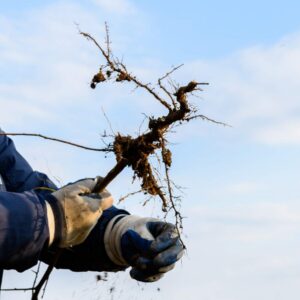
You can go out and spend money over and over again on bags of compost or synthetic fertilizers, sure. Or! You could choose plants that will increase fertility over the long term so that you don’t have to bring in nutrients from outside sources. But how exactly are these magical nitrogen-fixing plants creating this fertility? Well it turns out it is not the plant that is providing the fertility but a bacteria that lives within the root nodules of certain plant species.
The plant creates a home for the bacteria to live in within its roots, (a lumpy growth on the root that we call a nodule), and in exchange for the nitrogen provided by the bacteria the plant provides sugars and a place for the bacteria to live. The bacteria that are carrying out this chemical process are literally creating usable nitrogen out of thin air! They are taking the nitrogen that is already present in the air and converting it from a relatively inert form of nitrogen (N2) to being an easily accessible form of nitrogen in the form of ammonia (NH3) that plants can readily take up. In this way the nitrogen has been ‘fixed’.
Most Commonly Known
The nitrogen fixers that most people are familiar with are either cover crops or incredibly invasive plants, such as kudzu or scotch broom. Because of their nitrogen-fixing abilities these opportunistic plants are able to colonize disturbed or degraded soils very rapidly, sometimes to the point of total exclusion of any other species. For this reason we must be very careful when introducing nitrogen-fixers into new areas. And because of this ability to “heal” the soil, nitrogen fixing cover crops are very helpful for us when we are farming annual crops and trying to keep an ecosystem in a stage of early succession.
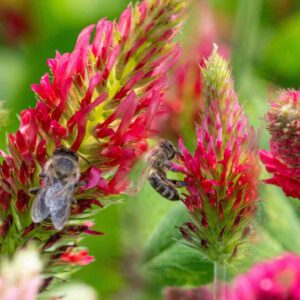
Most of the cover crops we use are legumes, in the Pea family. Almost all of the cover crops used in organic farming come from this family, including clover, alfalfa, vetch and fava beans. These plants all boost fertility in the soil and are tilled in as a green manure to create a boost of nitrogen and organic matter before you plant your main crop. This is a great way to manage soil fertility for annual crops that require constant disturbance of the soil, but how do we build fertility in our home orchards or food forests where we aren’t able to till in an annual crop every year? This is where perennial nitrogen fixing species come in!
Introducing the Eleagnaceae family
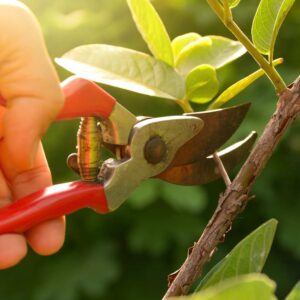
Plants from the Eleagnaceae family contains some of the most useful plants you could integrate into your home orchard! Check out Seaberry, Goumi, Autumn Olive and Silverberry. But there is a catch with perennial nitrogen fixers. While the annual ones are tilled into the soil to give a release of nitrogen, perennial fixers must be pruned back to release their nitrogen. They do not freely give away this nutrient to their competitors; rather they slowly build fertility over time through decomposition and root die off events.
We can expedite this fertility building process by encouraging large root dieback events whenever we prune our trees. Whenever you remove a branch from a tree there will be a corresponding root dieback event in the soil. This releases the organic matter from the roots as well as the nitrogen fixing nodules into the soil. When we harvest sea berries we cut the whole branch to freeze and pop off the berries. This process triggers nitrogen release!
Afterwards, we can then take the pruned branches and lay them on the ground to rot and build soil. Or, we could chop them up or chip them in order to speed up this composting process. By doing this, we are building soil and providing long-term fertility to our orchards. We are also sequestering carbon into the soil where it can become a nutrient rather than an atmospheric pollutant. Win-win!
Next time you’re thinking about going to pick up a few bags of fertilizer from the garden store, pause! Consider planting one of the many nitrogen fixing plants and perennial species that the botanical world has to offer, instead.
Still have questions about how to utilize nitrogen fixing companion plants?
Reach out to our customer service consultants – we’re happy to chat!
info@onegreenworld.com – (877) 353-4028