















Late winter is grafting season! The time of year to graft dormant hardwood cuttings and make some new baby fruit trees. Sharpen your pruners, sanitize your tools and collect your budwood! You, too, can start making your own trees! Be sure to browse our available rootstock and grafting tools as well.
Read on for our step-by-step guide to two easy methods to get grafting!
To Start
Collect your dormant scion wood
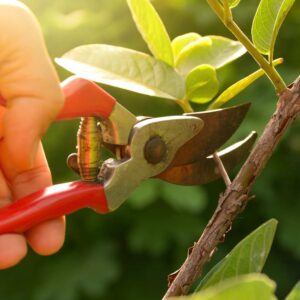
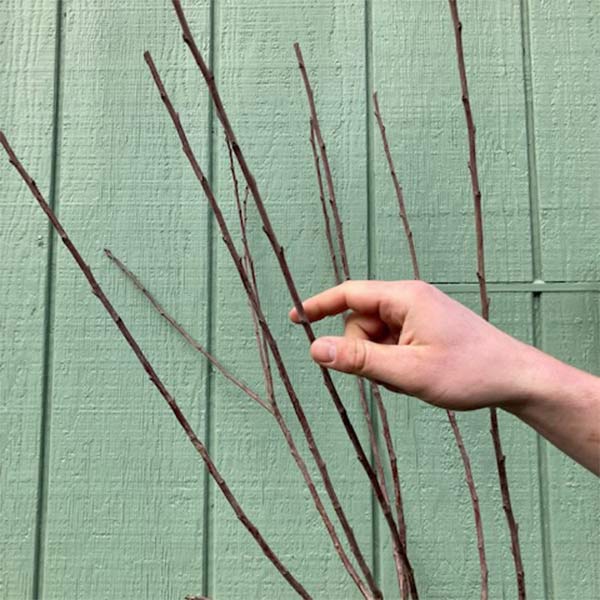
Scions must be cut while they are still fully dormant for the highest grafting success rate. Be sure to cut wood on new growth that is disease free and growing vigorously. The healthier and more vigorous your scion is, the greater chance of success when grafting and cultivating a fast-growing young tree.
Once your scion is cut, label it and store it in the refrigerator where it will easily keep for at least a month until you are ready to graft.
Selecting rootstock
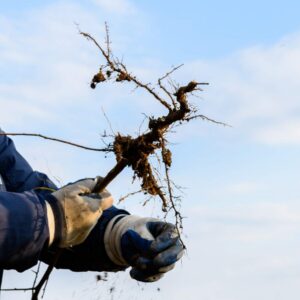
Rootstock is just as important as selecting the variety you want to grow. Many people think of height at maturity when considering rootstock, but several other factors can be selected for as well! Disease resistance, vigor, lifespan, soil adaptability, suckering, and how well anchored the tree will be are other aspects that rootstock can highlight. Checking in with gardeners/farmers in your area or your local extension agency can help you to choose the perfect rootstock for your location. And of course, trialing many different rootstocks for your location always yields valuable data.
Anatomy of Grafting
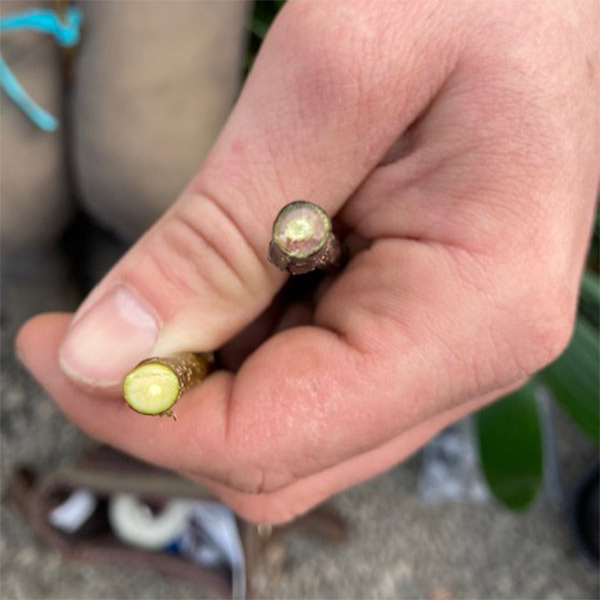
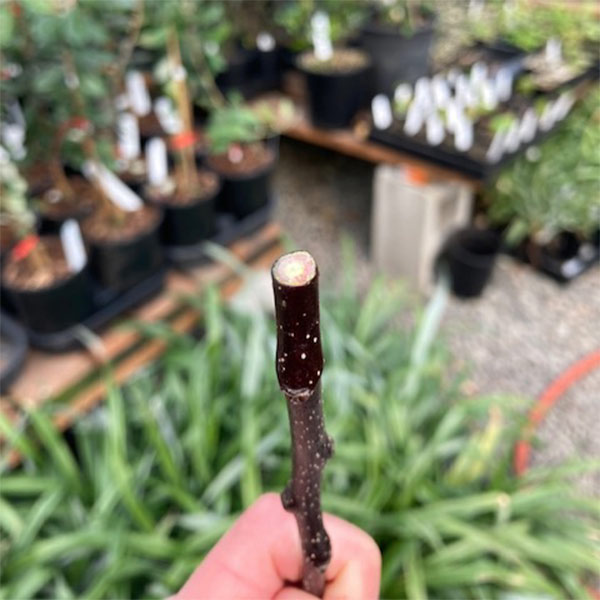
We realized a few years ago in one of our grafting classes that using red fleshed apples is a great way for beginners to clearly see the difference between the pith, sapwood, cambium, and bark. On the photo below, the pith is that white spot in the middle, the sapwood is red (light pink) in this case, and the cambium is the lighter layer beneath the dark red bark. The cambium is the most important part here, as it’s the layer that lines up between the scion and the rootstock in order to get the vascular tissue to fuse and form a successful graft union.
Prepare your Tools
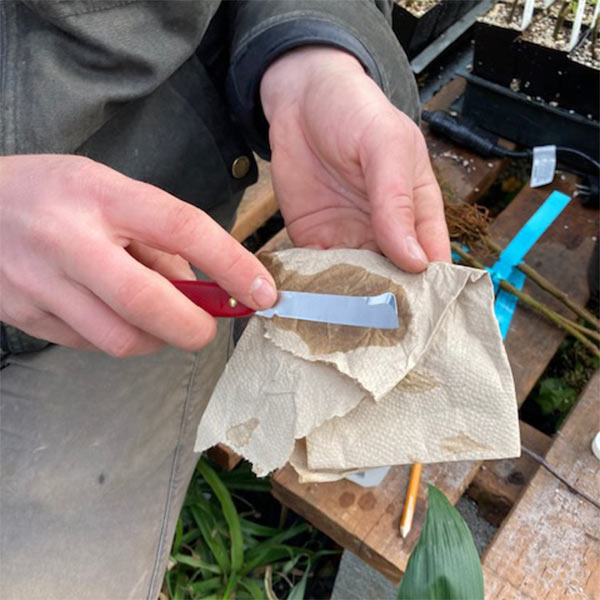
Be sure to sanitize all of your tools before you begin! This helps avoid potential spread of pathogens across plant material. We recommend 70% rubbing alcohol.
Make your Match
When choosing which individual piece of scion to graft onto each rootstock, it will be helpful to find diameters that are similar so that both sides of the graft match – but this is not essential. Rootstock and scion can vary in size, but matching one side perfectly will yield success.
The Wedge Method
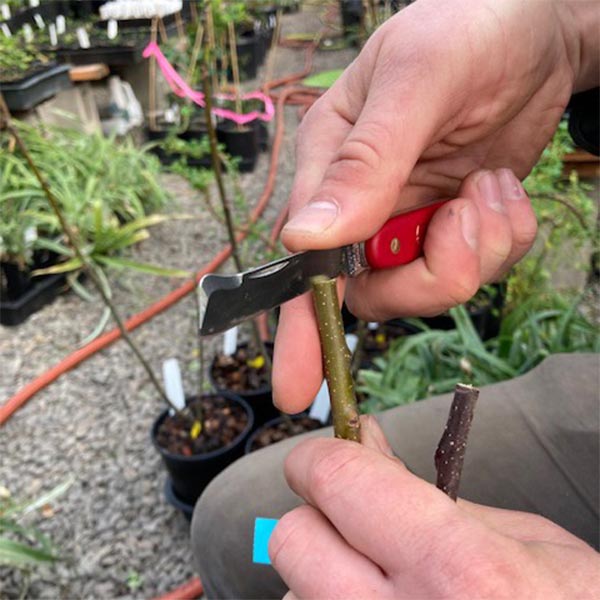
The first and easiest grafting style is the wedge graft. The take rate on these grafts is pretty high, and you don’t need a skilled grafter’s hand to find success with it.
First, make a split down the middle of the rootstock. It is important that the knife cuts the wood cleanly rather than having it split so that a more solid connection between scion and rootstock is achieved.
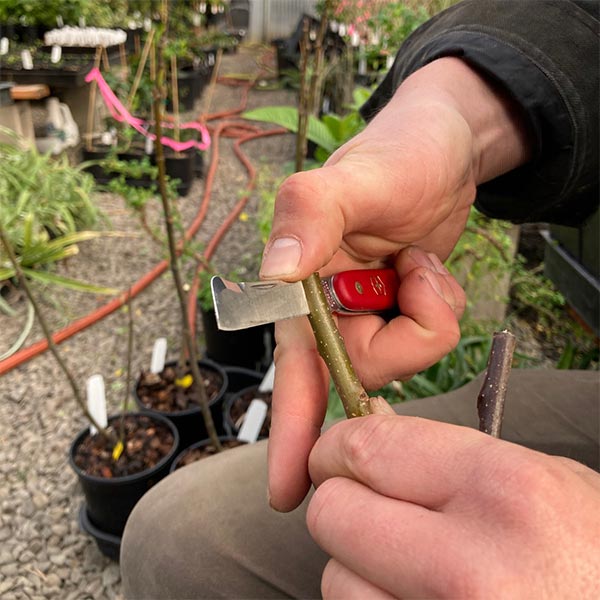
TIP: We often put our thumb on top of the blade and above the rootstock to ensure that the blade stops when our thumb hits the top of the rootstock. This ensures we don’t cut our other hand that’s holding the rootstock and keeps the blade from making too deep of a cut.
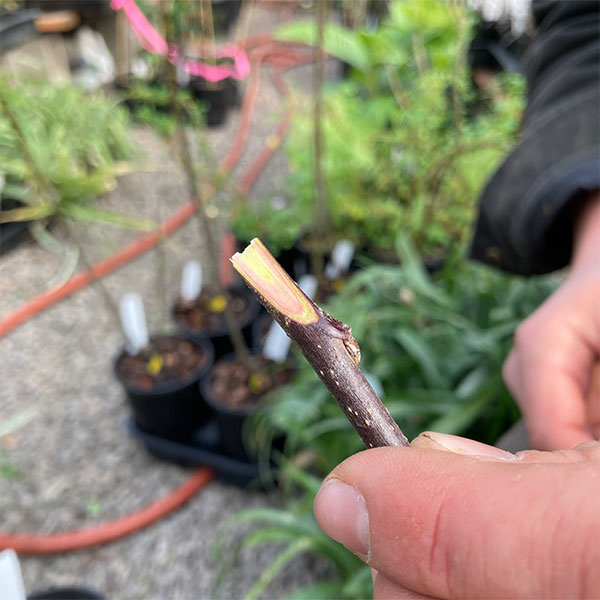
Next, cut the scion wood on both sides to form a wedge that tapers down to a very slim point. It is important to cut at a direct angle rather than “scooping” with the grain of the wood so that there are no air pockets between the cambium layers.
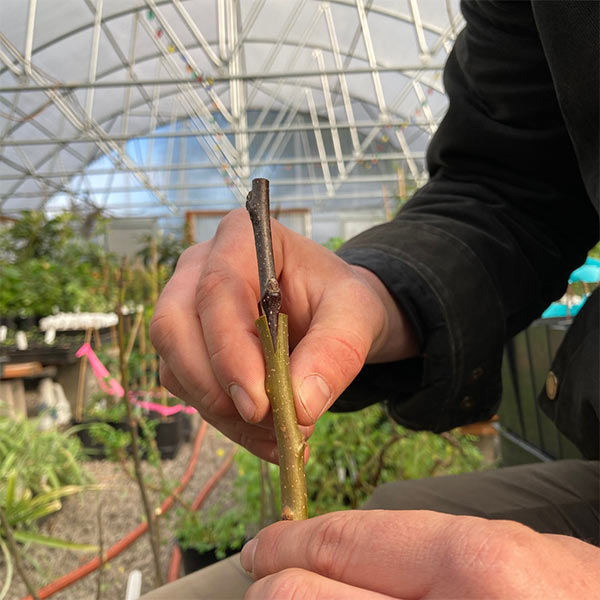
The scion should then fit neatly into the wedge you’ve created in the rootstock with no gaps between the two pieces of wood. It is better to line up one side perfectly than to put the scion right in the middle of the rootstock. Eventually as the young tree grows, it will fuse on both sides.
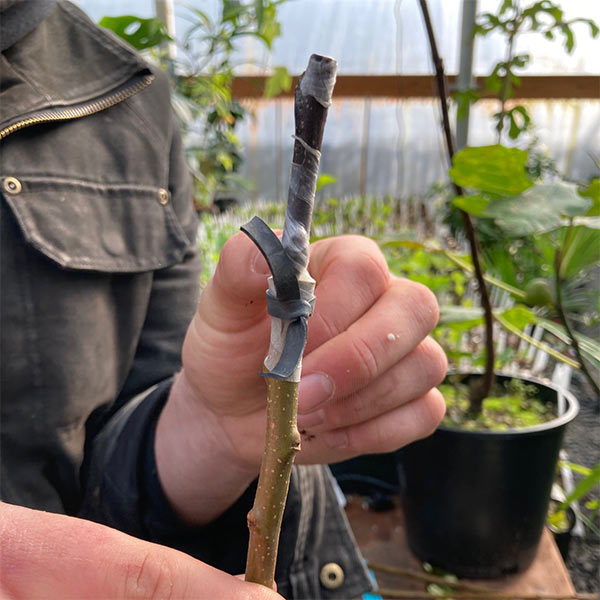
Wrap your scion with grafting tape and tie a rubber band around to hold tight, squeezing the rootstock to the scion. Some growers wrap scion completely to keep them from dehydrating, but with apples for example, it’s usually sufficient to put a small piece on the top (like a small hat) unless it’s an old or dehydrated piece of scion that you’re trying to save.
The Whip and Tongue Method
Once you’ve got the hang of wedge grafting, you can move on to the whip and tongue method. Success rate is similar with both methods once you’ve mastered them, though whip and tongue has the advantage of lining up the two pieces in a more fluid way. It also provides more structural integrity for the young graft due to interlocking the wood.
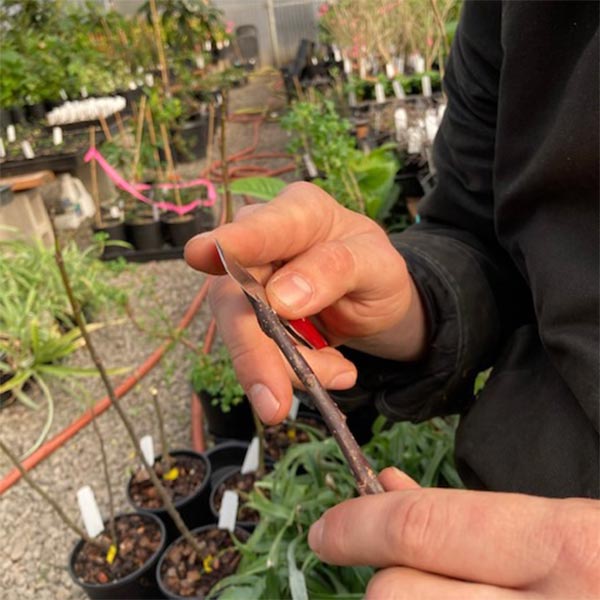
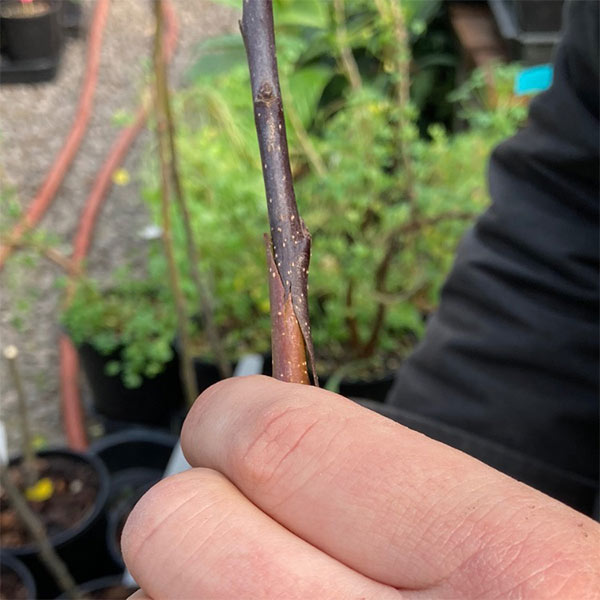
To create a whip and tongue graft, you’ll make a cut about 3/4″ long from one end of the scion diagonally across to the other. After this cut, make the “tongue”, a little incision into the middle of the wood – usually right where the pith is. Create a mirror cut on the rootstock, then interlock the two pieces together.
The trick here is getting the two tongues on either side of each other. We’ve found the budding tool on grafting knives can be helpful for opening the tongues up a bit, so they fit more easily into each other.
The interlocking pieces will help the young graft be more resilient to anything knocking it out of place. Follow the same finals steps from the wedge method above, securing it with grafting tape and a rubber band.
Final Steps
Pot up your newly grafted tree and put it in a frost-free location, but be mindful that it’s not too warm.
Note: We’ve found that for many of the more temperate plants, when fresh grafts are put into warm greenhouses too quickly, the scion will break dormancy before the graft can fully fuse, causing collapse. Other species such as figs and persimmons much prefer a hot environment while the grafts are fusing, but in the case of apples it’s best to either graft them after all danger of frost has passed or put them in a cool hoop-house or garage. The use of bottom heat from mats can be helpful as well, as it will cause the rootstock to begin growing and breaking dormancy more quickly while the cooler air above keeps the scion dormant.
Grafting your own trees is a fun (and economical) way to propagate young fruit trees. It’s also a valuable skillset of humanity, essential for orchardists, nursery workers, or anyone trying to conserve rare or sentimental varietals. Experiment with different techniques, rootstock combinations, interstems, and materials! You just might discover a unique new way to propagate your favorite fruit trees. Happy Grafting!