







A classic favorite: Blueberries! These easy to grow perennial shrubs produce abundant crops of delicious berries. In addition to delectable fruit, these plants add charm and beauty to your yard, garden or patio. Follow our guidelines on Blueberry Growing to succeed in cultivating your own fabulous blues!
Jump to: Site Selection, Site Preparation, Planting, Watering and Fertilizing, Pollination, Blueberry Types
SITE SELECTION
Blueberries like well-drained, acidic soil and ½ day to full sun. On wetter sites, where water drains slowly, Blueberries will like growing in 2-3 ft. wide, 8-12” high, raised beds.
SITE PREPARATION
Planting in acidic soil is one of the most important factors in success with Blueberries.
If pH needs adjustment, sulfur lowers it. Ideally you would do this several months before planting.
If you are planting in the ground, adding abundant amounts of pre-moistened peat moss to your soil will increase acidity and make a nice environment for your plants. For each plant, prepare an about 2ft. in diameter and 1 ft. deep. Work in about a cubic ft. of peat moss (usually about ¼ of a bale). Well-rotted fir or pine sawdust can be used as a substitute for peat moss. Do not use cedar sawdust as it can be toxic to the root system.
If you are growing your plants in containers, use a coarse, well-drained potting soil that is designed for acid-loving plants like Rhododendrons and Azaleas.
PLANTING
Highbush Blueberries can be planted as close as 3 ft. apart to form a hedge and 6 ft. or more apart to be grown as individual specimens. Lowbush and Dwarf Blueberries can be spaced as close as 2 ft. apart.
Remove your plant from the container and lightly loosen and spread out the roots. Remove any excessively long roots and then dig your planting hole large enough to comfortably accommodate the root system. Place the plant in the hole so that the top surface of the potting soil is at the same level or a little above the level of the soil surrounding the planting hole. Firm the soil around your plant and water well.
After planting, it is a good idea to mulch your plant with 3-4 inches of fir, hemlock or pine sawdust. This will conserve moisture, suppress weeds and contribute to soil acidity.
WATERING & FERTILIZING
Once planted and watered in well, your new plant should not need supplemental water for some time. If planting during warm, dry weather pay attention to the original potting soil and do not let it dry out. It takes several weeks for the roots to fully establish contact with the new soil. Summer watering should be done deeply and infrequently. A mulched plant should not require watering more often than once a week.
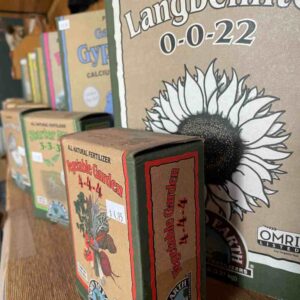
Blueberries like acidic fertilizers, like those used for Rhododendrons and Azaleas. Down to Earth Acid Mix is specially formulated for Blueberries. Blood meal, fishmeal, cottonseed meal and feather meal are also good, organic, acidic fertilizers for your Blueberries. Your plant will not need much if any fertilizer the first year. The year after planting, pull back the mulch in March and spread approx. 1/2 lb. of any of these fertilizers on the soil around the plant. Apply fertilizer annually for best results.
POLLINATION
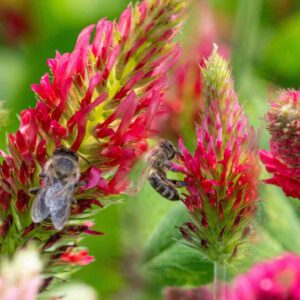
For best pollination results it is ideal to choose a pollinizer within the same blueberry “type” which share bloom time. In addition, matching a blueberry to its suited climate will play a role in production. The key below offers some indicators for which type will work best in your region.
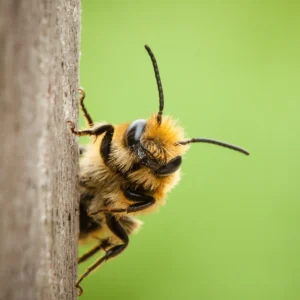
Consider Mason Bees to help pollinate and increase fruit production as well!
BLUEBERRY TYPES
Northern Highbush
These have a high chill hour requirement, and are very cold tolerant. Most northern highbush varieties are self-pollinating, but they will produce more, higher quality fruit with pollination partners.
- Average Size: 5-9′
- Hardiness: most between -15 to -30°F
- Great choice for the PNW
- Generally considered self-fertile and compatible with other Highbush cultivars
Southern Highbush
A lower chill requirement and high heat tolerance make Southern highbush blueberries perfect for growing in warmer climates, where they can present as partially evergreen. They bloom early in the spring, and so are prone to damage from late spring frosts.
- Average size: 6-8’ (4-6’ in northern regions)
- Hardiness: most between -10 to 5°F
- Great for regions with fewer chill hours
- Cross with other Southern Highbush or Northern with similar bloom time
Rabbiteye
These bushes grow much larger than highbush, as much as 15 feet tall and almost as wide. They are heat- and (somewhat) drought-tolerant and resistant to much of the disease and pest pressures of hot, humid climates. They also have a lower chilling requirement, but they are still somewhat tolerant of cold temperatures (down to 10°F) as long as the cold isn’t too prolonged.
Even though they need fewer chill hours, rabbiteye blueberries bloom relatively late in the spring, which provides some protection from late frost damage.
- Average size: 6-15’
- Hardiness: around 10°F
- Great for long hot summers
- In PNW fruit ripens late summer early fall
- Not self-fertile, need another rabbiteye cultivar to set fruit
Half-High
Half-Highs are a cross between the big-berry producing highbush varieties and the cold-tolerant wild lowbush species. Hardy in USDA zones 3-5, half-high blueberry bushes are less likely to suffer from winter damage than highbush plants.
- Average size: 3-4’
- Hardiness: very hardy, most down to -35°F or lower
- Choose these cultivars in colder regions where other blueberry’s can’t grow
- Great for container growing!
- Cross with Highbush cultivars with similar bloom time
Lowbush
Often known as “wild” blueberries. Lowbush are hardy shrubs, native to the colder regions of the country and thriving in USDA zones 3-7. These cultivars grow to knee-height or shorter, with a sprawling nature. Berries are small and very sweet. These fruits require winter chill of 800 – 1000+ hours.
- Average size: 1-2’
- Hardiness: most around -30°F
- Low growing shrubs that spread from underground stems
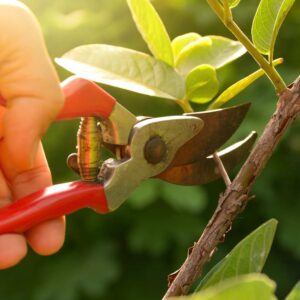
- Beneficial to cut the plants back every 2-3 years to refresh fruiting branches
- Not self-fertile, cross with lowbush or Highbush cultivars with similar bloom times
We know our favorite blueberry varieties, how about you? Connect with us to discuss details about our extensive collection! We’re happy to provide cultivar suggestions, dish flavor profiles, talk soil pH, or just about anything else pertaining to your fruiting venture. We’re here to help!
info@onegreenworld.com – (877) 353-4028