






PLANTING
Thank you for ordering from One Green World! Please use this guide ensure success with your new plants. Even if you are an experienced gardener, reviewing these guidelines can help your plants thrive. Happy Growing!
Jump To: Planting Site, Prep Your Plant, Prep the Site, Plant Your Plant, After Planting, Flowering and Fruiting, Pruning, Fertilizing, Mulching, and Watering
WELCOMING YOUR NEW PLANTS
BARE ROOTS:
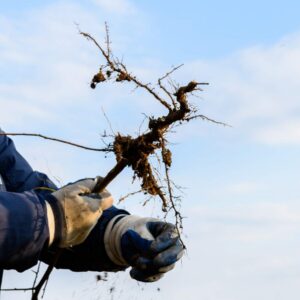
Open the bag surrounding the roots and if the roots are dry, sprinkle some water in the bag. You may soak the roots in a bucket of water for 2-4 hours before planting to rehydrate them.
- Immediate planting: If the weather is suitable to work in and the soil is workable, immediate planting is best.
- Delayed Planting: If you need to delay planting while the weather is cool, then planting bare roots in a temporary container is recommended. Find a large enough container to accommodate the roots of the plant and cover with sawdust or well-draining potting soil. Keep the tree in either a cool garage or shelter if extremely cold temperatures persist. Do not bring into a warm house as it will cause the plant to break dormancy prematurely. Plant as soon as the soil is workable and transplanting prior to dormancy break is preferred.
- *If using potting soil, make sure it does not contain a high concentration of fertilizer as this can burn the dormant roots.
CONTAINER PLANTS:
Remove wrapping material and if the pot seems light and the soil seems dry, water the plant well. Plants can remain in their container until ready to plant and just be sure the soil does not dry out. If the weather is cool or if your plant is dormant and without foliage, it will require minimal watering. Over-watering is the most common cause of death of containerized plants.
*Most plants shipped between Fall-Spring will be dormant and may not have leaves upon arrival. While this can be alarming, it is completely normal for the plants to lose their leaves and go dormant for winter. You can check on the health of the plant by scratching the outer layer of bark on the main trunk. If the cambium layer underneath is green, then the plant is alive, healthy, and dormant. If the layer appears brown, please contact us within 10 days of arrival*
PLANTING SITE
Most fruiting plants like full to 1/2-day sun and well-drained soil. Clay soil is not a problem as long as it is not waterlogged. If you have waterlogged soil, we recommend amending with organic material, or mounding the soil to improve drainage.
PREPARE YOUR PLANT
- BARE ROOTS: Inspect the roots and cut off any broken or overly long ones.
- CONTAINER PLANTS: Remove the pot and loosen the root system. If it is very dense, lay the plant on the ground and press hard on the root ball with the palm of your hand to loosen it. Tease some roots out of the root ball and trim back any overly long roots. *For pawpaws, we do not recommend disturbing the roots.
PREPARE THE SITE
Remove any weeds or grass in a circle 2-3 ft. in diameter. This will prevent competition with your new plants for water and nutrients. Dig a hole that is just as deep as the root ball and 2-3 times wider. Rough up the sides of the hole with your shovel so that your plants roots can easily spread.
PLANT YOUR PLANT
BARE ROOTS:
Locate the root flare on the trunk, indicated by a change in color, often from a dark green to yellow or black, and by a bulge in the trunk where the roots begin. Be sure that this point is no lower than the soil level surrounding your planting hole. Grafted trees should be planted so that the graft is 2-5 inches above the soil line. Do not cover the graft. You can ignore any paint on the trunk of your bare-root plant. It is for identification at the nursery and is not related to planting depth. Backfill the hole with the soil you dug out and when the hole is full, tamp down the soil then water your plant in well. Your new plant is now ready to grow!
CONTAINER PLANTS:
The current soil line in the pot should be accurately at the root flare, but removing some of the dirt to double check is recommended. The root flare is indicated by a change in color or by a bulge in the trunk where the roots begin. When placing the plant in the hole, it is very important that the soil line is no lower than the soil line surrounding the planting hole. Make a small mound of soil in the middle of the hole. Place your plant on top of this mound at the proper planting depth and let the roots drape down the sides of the mound – make sure the roots are spread out. Backfill the hole with the soil you dug out and when the hole is full, tamp down the soil then water your plant in well. Your new plant is now ready to grow!
*We advise back filling the planting hole with the native soil that came from it. This will allow the roots of your plant to grow far and wide into the surrounding soil. We do not recommend adding other materials to this soil as this will encourage roots to remain in that location, which weakens the plant. Exceptions to this rule are Blueberries, Tea, and other acid loving plants. For these you may need to add peat moss or other acidic materials. *
AFTER PLANTING
FLOWERING & FRUITING
Some plants will want to bloom and fruit the first year. While this is fine for containerized plants, for bare-root plants it is best to remove the flowers and fruit the first year so the plant can direct its energy to rebuilding the root system.
PRUNING
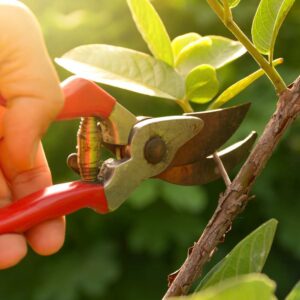
Because bare-root plants have been dug up from the nursery, their root systems have been reduced in size. To balance the branches with the roots, the trees have been professionally pruned prior to shipment to balance the root to shoot ratio. No additional pruning is needed upon planting besides removal of any broken or damaged branches. Cut these back to below the damaged area. If you picked up your tree at our retail location, be sure to prune some of the upper branches to balance them out with the root system. Check out our winter and summer pruning guides for continuous care each season.
FERTILIZING
Your newly planted bare-root plants will not need or be able to uptake fertilizer until their roots are established. The only fertilizers we recommend using immediately after planting are slow acting organic materials, soil inoculants, and compost spread on the surface of the soil around the base of the plant. Plants grown in containers will benefit from periodic applications of a balanced, organic fertilizer.
MULCHING
We highly recommend applying mulch of organic material around your new plant (and older ones as well). A thick layer of straw, compost, rotted manure, wood chips, sawdust or other material will inhibit weed growth and conserve water. As it decays, mulch will also supply nutrients to your plants. Mulch should be kept at least an inch or two away from the trunk of your plants to allow the bark to dry out and breathe.
WATERING
- Frequency: For all plants, periodic deep watering is far superior to frequent light watering.
- Deep watering: This encourages deep root growth, making your plant stronger and much less susceptible to drought stress. In our experience, far more plants are damaged or die from over watering than under watering. We recommend 3-5 gallons per week either through rain or irrigation and increased watering during hotter periods.
- Newly Planted Bare Roots: If you planted a bare-root plant, it will be several weeks before its roots begin growing and it will not require much watering to keep the soil moist at first.
- Newly Planted Potted Plants: If you planted a containerized plant, it may need water after a few days, especially in the area right around the plant. The original potting mix can dry out much more quickly than the surrounding soil.
If you have any questions about caring for your plants, please reach out to our customer service staff via email or voicemail and we’re happy to chat!
info@onegreenworld.com – (877) 353-4028