








Pawpaw’s (Asimina triloba) are one of the most unique fruits that can be grown in the North American backyard orchard. Pawpaw’s are the only member of the Annonaceae, or custard apple family, adapted to temperate regions.
Tropical relatives include the cherimoya, atemoya, guanabana, and soursop! It’s easy to see the resemblance between the pawpaw fruit and that of its tropical cousins. Everything about this plant, from its leaf size and shape to the way its fruits look, tastes and smells tropical. But yet, it is cold hardy to zone 5 and can be grown in temperate climates coast to coast!
Jump to: Site Selection, Transplanting, Plant Spacing, Pollination, Pests and Disease, Varietal Selection, Using Pawpaw Fruit
How to establish your Pawpaw plants
To successfully grow pawpaw fruit we must first understand a few things about its natural history. The tree grows primarily in river floodplains and shady rich bottomlands. They form dense groves, spreading clonally by underground runners and spend many years growing as an understory species. When there is a break in the canopy, they can then make their leap to sunnier conditions. It is only once they are growing in fuller sunlight that they produce significant crops of their delicious fruit. These are the conditions we must emulate in order to successfully grow healthy pawpaw’s!
Site Selection
Rich, deep, well draining soils are ideal conditions for planting your new paws in. Although they grow in river floodplains that may become seasonally inundated, pawpaw does best when it has deep well-drained soil with a pH between 5.5 and 7.0. To mimic the understory conditions needed for its establishment, plant on the north side of a fence. This will cause the pawpaw will be shaded while it’s young. It will then receive full sunlight as it matures and grows above the fence line.
Another option is to establish a quick growing nitrogen fixing tree or shrub on the south side of your future pawpaw. Get this tree established a year or two year before so it can provide adequate shade. Choosing nitrogen-fixing species gives your pawpaw a fertility boost, as well as neeed shade. This support tree can be cut down a few years later once your pawpaw is established and the danger of sunscald is no longer a threat.
Planting in a site that is as humid as possible is ideal . Near a pond can be a great place to plant if you are in an area with dryer summers.
Transplanting
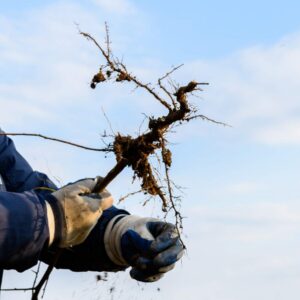
The paw paw can be a very difficult species to transplant. It has a very deep root system and does not like its roots to be disturbed or broken. For this reason we sell pawpaws while they are still quite small to ensure higher transplant success rates. While the plant is dormant, or in the spring just after bud break, is the best time to transplant. Be very careful not to disturb the roots. Water in well just as you would any other tree and keep very well watered for the first couple years.
Plant Spacing
Pawpaw’s can be spaced relatively close together, even as close as 5 feet. This is the best way to mimic the dense groves that pawpaw’s form in the wild. It’s believed that pawpaw’s actively graft their roots together and share nutrients more readily than many other species. Dense spacing helps to achieve this. Plant as close as 5 feet or as far as 10 feet apart, and plant at least three different varieties for cross-pollination.
Pollination
Pollination can be the major limiting factor to getting good crops of pawpaw fruit. The flowers are protogynous meaning that the female organ, the stigma, ripens before the pollen does. This means the female flower is not receptive when the pollen is ripe. This ensures that the flower cannot pollinate itself. The entire tree is also usually self-incompatible, meaning that pollen from one flower on the tree will not pollinate the stigma of other flowers on the same tree.
Therefore the pawpaw requires pollination from a tree with entirely different genetics to be successfully pollinated. This is why we always suggest purchasing many different paw paw varieties to ensure the most successful pollination. The more trees you have the more successful your pollination will be. Two varieties is the absolute minimum you can plant to get fruit but more fruit is produced with three or more varieties.
Finally, you must attract the pawpaw’s natural pollinators to achieve successful transfer of the pollen between flowers. In this case keeping honeybees will not help you out as the pawpaw flowers are designed for the decomposers of the world. They are a deep and beautiful reddish purple color and smell a bit like rotting flesh in order to attract various species of flies and beetles. One strategy for attracting these pollinators is to put road kill or rotting meat near your pawpaws when they are flowering to attract their natural pollinators. If this sounds too unappealing to you it is also possible to pollinate by hand, just be sure that once the tree starts setting fruit that no single branch is too loaded up with fruit or it may cause it to break or result in smaller fruits.
Checkout a more in-depth look into pawpaw pollination HERE.
Pests and Diseases
The pawpaw is relatively pest and disease free. If you have deer problems in your area then pawpaw trees are a wonderful choice. Deer avoid eating pawpaw leaves even in areas where deer populations are sky high. A few insect pests exist, but most are relatively minor.
The pawpaw peduncle borer (Talponia plummeriana) burrows into the flowers causing them to wither and drop and can even destroy the majority of blossoms, although this is rare. Other pests in the Eastern United States include the Zebra Swallowtail Butterfly (Eurytides marcellus) whose larvae feed exclusively on young pawpaw leaves. The relationship between the Zebra Swallowtail and the pawpaw is similar to that of the Monarch butterfly and the milkweed plant.
The acetogenins that are present in the paw paw leaves remain present in trace amounts in the Zebra Swallowtails body for the remainder of its life, making it unpalatable to birds or other predators. The incredible beauty of the Zebra Swallowtail and the minimal damage it does to the leaves make this insect not much of a concern. A blue stain disease can also infect paw paws but it is not believed that a microbial agent is responsible for this but rather it is a result of stress or trauma to the tree. In general pawpaws are one of the most disease and pest resistant fruit trees that you can grow.
Varietal selection
The best way to select your varieties is to contact your local agricultural extension agency and ask them which pawpaw varieties will grow best in your area. In general, we recommend the earlier fruiting varieties for areas where summers are not as humid as the eastern United States where the pawpaw is native.
Using the Pawpaw Fruit
The fruit is primarily used for fresh eating. It is extremely perishable and is amazingly delicious when it is perfectly ripe. It can be used much like you would use a banana. Try replacing bananas with paw paw fruit in a banana bread recipe or adding paw paws to a berry smoothie. For longer-term storage you can freeze the fruit and make ice cream out of it. Any recipe that requires adding heat or cooking the pawpaw is not recommended as the flavor compounds are extremely volatile and cooking can destroy the delicious pawpaw flavor, although it seems to retain a good flavor when mixed with flour and used as a baking additive.
Let us know about your experiences with pawpaw, which varieties work best in your area, what recipes you’ve found to use them in, and what strategies have been successful for getting them established on your yard! We love hearing from our community!
info@onegreenworld.com – (877) 353-4028